Eastern State Penitentiary
Philadelphia, Pennsylvania, United States
Prison · established
The Story
Voices, darting shadows and faces glimpsed in cellblocks belong to Eastern State’s ghost lore. Philadelphia’s preserved prison also tells a demanding human history. Visitors may explore through its historic-site programs, but the operator expressly prohibits paranormal investigations and investigation equipment.
The Hauntings
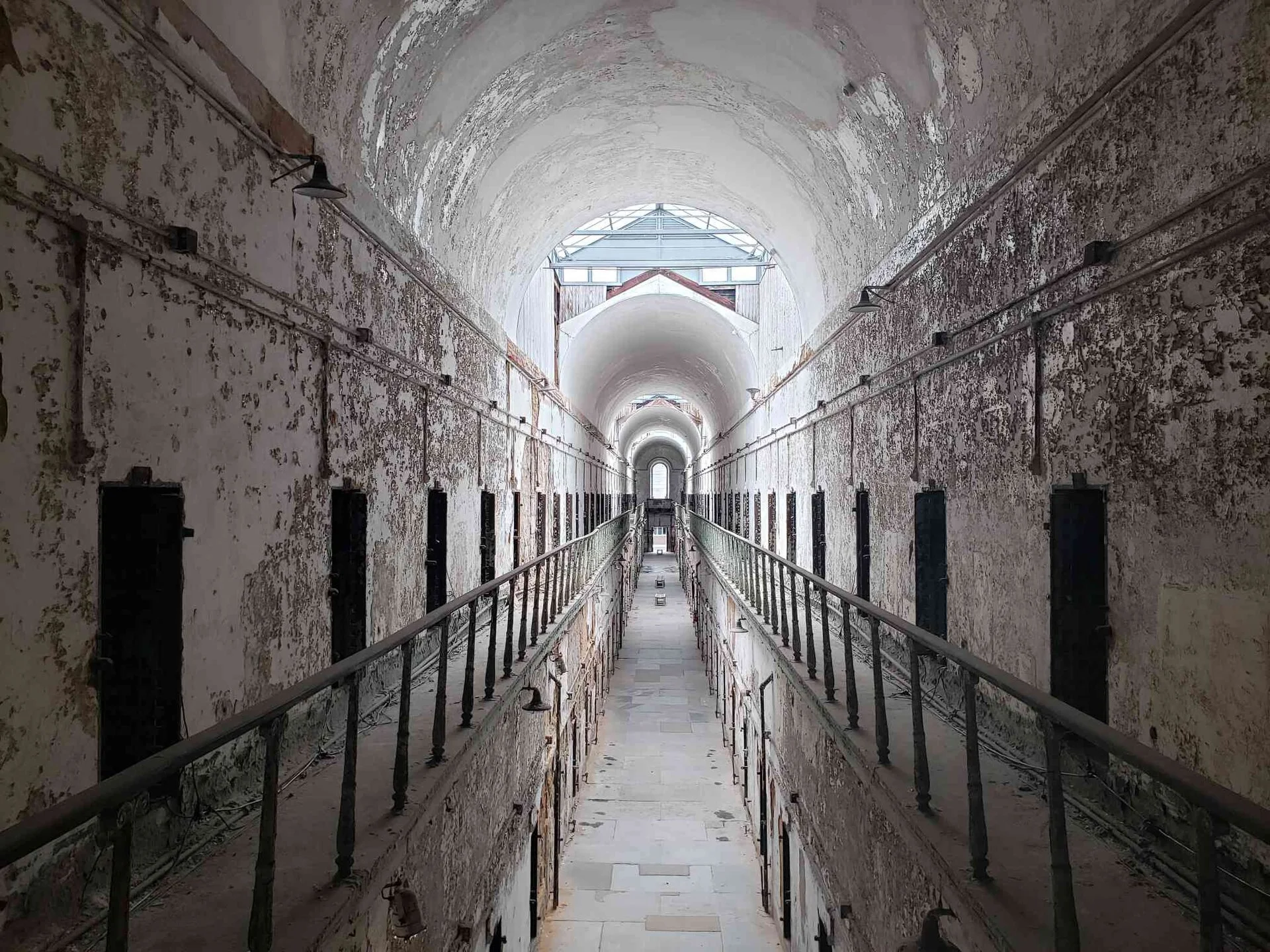
Long cellblocks extend from a central hub, turning the building’s original system of surveillance into something visitors can still see. Its Gothic exterior was meant to intimidate. Inside, today’s museum follows the lives affected by confinement and the arguments that shaped prison reform. Alongside that public history, a separate body of ghost stories has gathered around the corridors, cells and towers. Laurel Dalrymple’s 2013 NPR report gathers a recognizable geography of encounters: voices and laughter in Cellblock 12, moving shadows in Cellblock 6 and ghostly faces in Cellblock 4. Other accounts describe footsteps, whispers and a guard-like silhouette in a tower. The repetition gives these stories a place-specific character rather than a single apparition haunting the whole prison. The same report recounts an experience attributed to locksmith Gary Johnson in the early 1990s. After opening an old lock in Cellblock 4, he described being unable to move and seeing faces against the cell walls, one seeming to beckon. The account stands apart from the site’s staged seasonal attractions. Eastern State’s historical programs focus on the people confined here and the continuing impact of incarceration.
The History
Eastern State received its first prisoner in 1829 while construction was still underway. Architect John Haviland arranged cellblocks around a central observation hub. The Pennsylvania System combined isolation with labor, seeking penitence through separation. The institution formally abandoned that system in 1913, although crowding had already eroded its strict separation of prisoners. The prison continued operating until 1970 and briefly served as a city jail in 1971. Years of vacancy brought deterioration and a threat of demolition. Preservation efforts eventually led to public hard-hat tours in 1994. Today the buildings remain partly ruined, but they are managed as a historic site with exhibitions and interpretation, not as an abandoned prison available for unrestricted exploration.
A sense of place.

Visitor Experiences
Have you experienced something here?
This future chapter will bring together stories from the PHASM community. An unexpected encounter, a lingering feeling, or a quiet visit—your experience will be welcome.
Submissions are not open yet.
Sources & further reading.
- Eastern State Penitentiary Historic Site — History of Eastern State Penitentiary (history)
- Eastern State Penitentiary Historic Site — Know Before You Go (history)
- NPR / KPBS Public Media — Is Eastern State Penitentiary Really Haunted? (reports)
- Eastern State Penitentiary Historic Site — History of Eastern State Penitentiary (reports)
- Eastern State Penitentiary Historic Site — Know Before You Go (visiting)
Plan Your Visit
Buy daytime historic-site admission for self-guided audio interpretation or a guide-led tour and discussion. Paranormal investigations—including EVP recorders and other investigation equipment—are not permitted. Stay within marked visitor areas. Personal photography has its own rules; tripods and some other equipment require a pass, while commercial shoots or access to nonpublic spaces require advance arrangements. Use the official FAQ for current conditions.